Pakistan Declares Open War on Afghanistan as Kabul and Major Cities Are Bombed
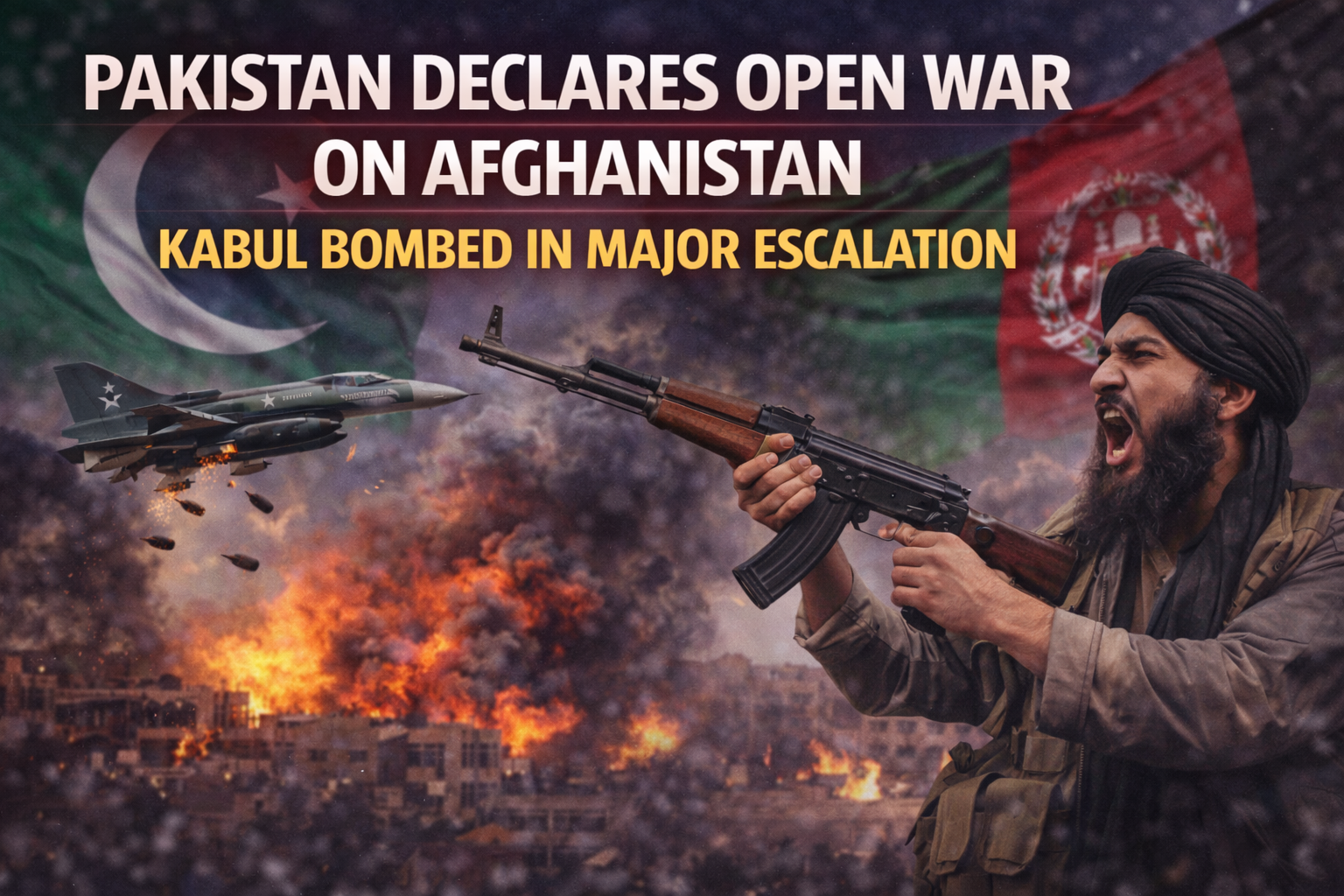
In a dramatic escalation of regional tensions, Pakistan declares open war on Afghanistan after conducting air strikes on the Afghan capital Kabul and other strategic locations. The announcement by Pakistan’s defence minister marks one of the most serious military confrontations between the neighbouring nations in years, threatening to destabilize South Asia and raise concerns across the global community.
What Led to Pakistan and Afghanistan’s Escalation?
Pakistani warplanes targeted several Afghan cities, including Kabul, Kandahar and Paktia, prompting Taliban authorities to report explosions and anti-aircraft fire in the capital. Islamabad’s Defence Minister Khawaja Asif said Pakistan’s patience had “run out” after repeated attacks on its military positions along the shared border.
This move followed weeks of tit-for-tat border clashes and strikes in the eastern provinces, where Afghan forces and Pakistani troops have exchanged fire. Both sides accuse each other of aggression, with Afghanistan claiming its forces were responding to previous Pakistani operations.
Military Operations Intensify Along the Durand Line
The Durand Line, a 2,611-kilometer border separating Pakistan and Afghanistan, has been a flashpoint for decades. Recent hostilities reflect deepening friction, with Pakistan blaming Afghan territory for harbouring militant groups, including the Pakistan Taliban. Islamabad says these groups have launched attacks from across the border, fueling a cycle of violence.
While Islamabad claims to have killed more than 130 Taliban fighters and destroyed multiple positions, Afghan authorities dispute these figures, reporting its own casualties and capturing Pakistani military outposts.
Pakistan’s Justification for an “Open War” Declaration
Defence Minister Khawaja Asif framed the escalation as a necessary defensive response to what he described as escalating “aggression” by Afghan forces. He told national and international media that Pakistan’s armed forces were prepared to guard the country’s security, sovereignty and territorial integrity.
Pakistan’s prime minister echoed this sentiment, emphasising that the nation stands united behind its military in deterring threats. Political leadership in Islamabad appears to be consolidating support for a robust military posture as clashes continue.
Afghanistan’s Response to Bombing and Border Clashes
The Taliban-led Afghan government, while acknowledging the air strikes, denied civilian casualties in Kabul and other cities. Taliban spokesperson Zabihullah Mujahid described Pakistan’s attacks as unprovoked but maintained that Afghan forces have launched large-scale defensive operations along the frontier.
Afghan officials also stated that some Pakistani military bases and posts were targeted by their forces during cross-border exchanges, framing their actions as retaliation for earlier strikes.
Impact on Civilians and Border Communities
The sudden escalation has put immense pressure on local communities near the border. Refugee camps and villages in Nangarhar and Paktika provinces have witnessed displacement and reports of civilian casualties. Humanitarian concerns are mounting as residents seek safety from shelling and aerial bombardments.
Uncertainty and fear have spread among families whose lives have already been shaped by decades of instability and conflict. Aid organisations have urged restraint and emphasised the need to protect non-combatants amid intensifying hostilities.
Historical Context: Pakistan-Afghanistan Relations
Relations between Pakistan and Afghanistan have been fraught for decades, shaped by ethnic ties, insurgency dynamics, and geopolitical rivalries. The presence of militant groups operating along the frontier has long been a source of mutual suspicion, with Islamabad accusing Kabul of harbouring fighters opposed to its interests.
The situation deteriorated amid clashes in October, when dozens of soldiers and civilians were killed on both sides. Ceasefire attempts mediated by Qatar and Turkey in late 2025 failed to produce lasting peace, and diplomatic ties remained strained.
Regional Security Implications
The current conflict threatens to expand beyond a bilateral confrontation. Neighbouring countries and global powers have already called for restraint, noting that a sustained war could destabilise the broader South Asian region. Analyses point to potential economic setbacks and refugee flows as major consequences of prolonged military engagement.
There are also concerns that militant groups and proxy actors could exploit the conflict, further compounding instability. Some observers worry that external influence from rival states could intensify pressures on both Islamabad and Kabul.
Diplomatic Responses and Global Calls for Peace
International entities, including the United Nations, Russia and Iran, have urged both countries to de-escalate and seek diplomatic solutions. Global leaders stress that military escalation could reverse years of progress on peace negotiations and economic cooperation in the region.
Efforts at mediation are reportedly underway, but with Islamabad’s “open war” stance and Kabul’s defensive posture, achieving a ceasefire appears increasingly challenging.
What Lies Ahead?
Forecasts remain uncertain as both sides show little sign of retreat. Analysts suggest that without diplomatic intervention, the conflict could deepen, leading to more air strikes, ground clashes, and potentially significant displacement of civilians.
International pressure for peace talks, however, may intensify as regional economies, especially in South Asia, feel the ripple effects of heightened military action. The world will be watching closely as developments unfold.
forbesbbc.blog
The declaration of “open war” between Pakistan and Afghanistan represents more than an escalation in border hostilities — it reflects a fault line in regional geopolitics where longstanding security dilemmas intertwine with modern strategic competitions. For readers of forbesbbc.blog, this conflict underscores how fragile economic growth and investment climates can rapidly unravel when neighbouring states resort to force. Beyond battlefield outcomes, the true test will be whether economic actors and diplomatic actors can create incentives for peace, long before military escalation exacts its gravest toll.