India EU Free Trade Deal Nears as Trump Tariff Uncertainty Grows
Why the India EU Free Trade Deal Matters Now
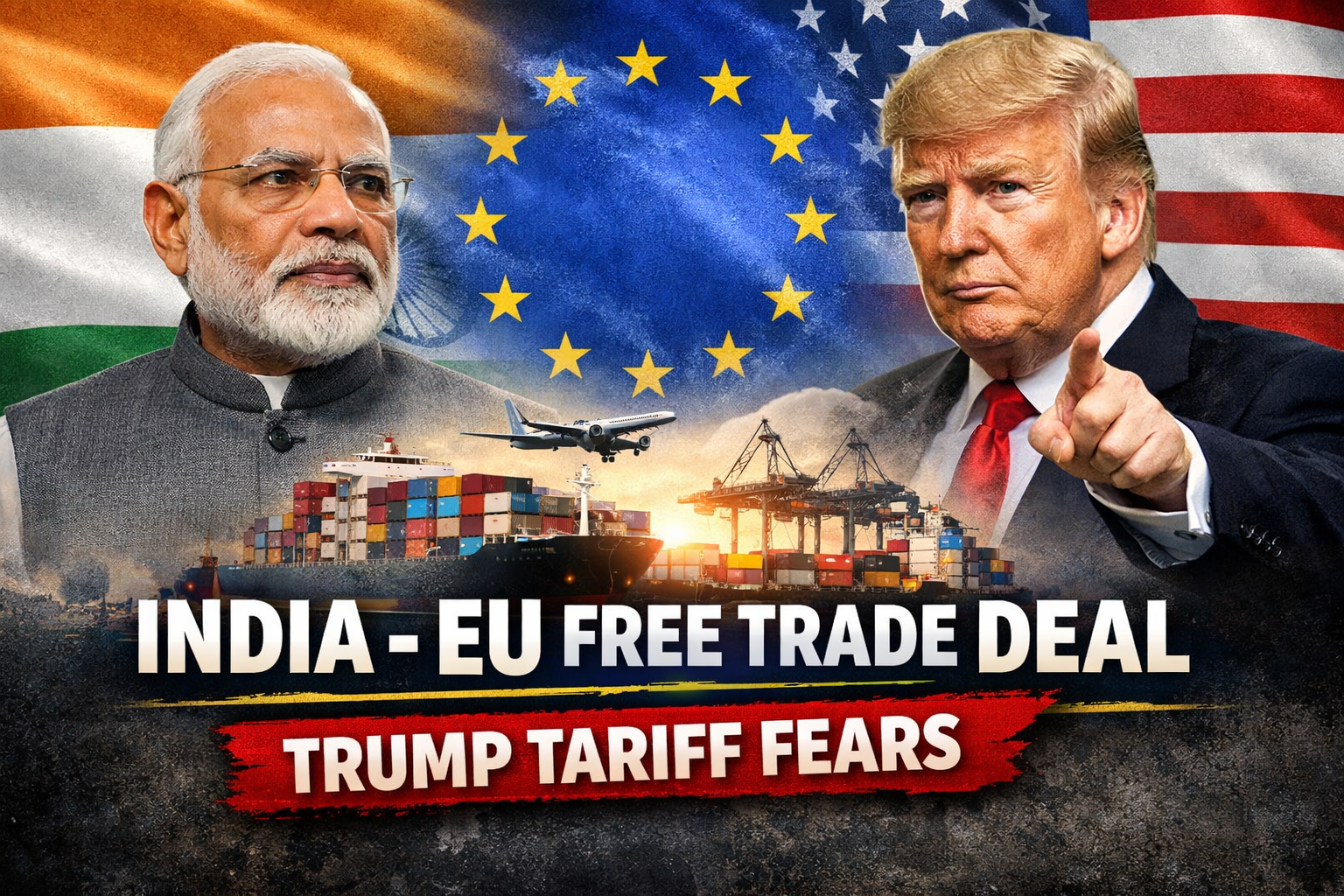
The India EU free trade deal has emerged as one of the most significant global trade negotiations in decades, arriving at a moment of heightened geopolitical uncertainty. As former US President Donald Trump renews tariff threats against key allies, India and the European Union are accelerating talks to finalize what leaders are calling the “mother of all deals.”
European Commission President Ursula von der Leyen and European Council President António Costa are set to attend India’s Republic Day celebrations, underscoring how strategically important the agreement has become for both sides. After nearly 20 years of stalled negotiations, political momentum has finally aligned with economic necessity.
Trump Tariffs Accelerate India EU Trade Talks
Trade uncertainty driven by Trump’s unpredictable tariff policies has acted as a catalyst. With Washington maintaining a 50% tariff stance on Indian goods and threatening Europe over Greenland-related tensions, both India and the EU are seeking reliable alternatives.
Experts say the India EU free trade deal allows both sides to reduce dependence on volatile partners. For India, it helps cushion the impact of US tariffs. For Europe, it offers diversification away from China, which Brussels increasingly views as an unreliable trading partner.
Economic Scale of the India EU Free Trade Deal
The numbers involved are staggering. India is on track to surpass $4 trillion in GDP, overtaking Japan as the world’s fourth-largest economy. Combined with the EU, the agreement would create a market of nearly two billion people, representing 25% of global GDP.
India already exports around $76 billion worth of goods to the EU annually. However, the withdrawal of the EU’s Generalised System of Preferences (GSP) in 2023 weakened the competitiveness of Indian exports. A finalized FTA would restore tariff advantages and significantly boost sectors like:
- Pharmaceuticals
- Garments and textiles
- Steel and petroleum products
- Machinery and industrial goods
What Europe Gains From the Deal
For the EU, closer trade ties with India mean access to one of the fastest-growing consumer markets in the world. The bloc has already signed major agreements with Japan, Vietnam, South Korea, and Mercosur — making India the next strategic priority.
European companies stand to benefit from reduced tariffs on automobiles, wine, spirits, and high-value manufactured goods, albeit through a phased approach to protect India’s domestic industries.
Sensitive Issues Still Blocking Final Approval
Despite optimism, several obstacles remain.
Carbon Border Adjustment Mechanism (CBAM) is a major sticking point. India argues that Europe’s carbon tax acts as a hidden tariff, disproportionately harming Indian MSMEs through high compliance costs and complex reporting requirements.
Intellectual property rights are another area of disagreement, with the EU seeking stronger patent protections and stricter data governance frameworks.
India, meanwhile, remains cautious about opening politically sensitive sectors such as agriculture and dairy, which could face domestic backlash if exposed to European competition.
Strategic and Geopolitical Implications
Beyond economics, the India EU free trade deal sends a powerful diplomatic signal. It demonstrates India’s commitment to a diversified foreign policy and Europe’s intent to strengthen partnerships outside the US-China axis.
Analysts suggest the deal could accelerate global trade decoupling, reducing vulnerabilities to tariff weaponization, export controls, and supply chain disruptions.
India’s recent reduction in Russian oil imports may also ease political resistance within the European Parliament, whose approval is mandatory for the deal to take effect.
Is This Truly the “Mother of All Deals”?
Whether the agreement becomes a transformative partnership or a strategically asymmetric compromise depends on how unresolved issues are handled. Still, most economists agree the long-term outlook is positive.
With geopolitical risks rising and trust in traditional trade partners eroding, the India EU free trade deal represents a pragmatic response to an increasingly fragmented global economy.
ForbesBBC.blog
The India EU free trade deal reflects a broader recalibration of global economic alliances in an era defined by tariff volatility and strategic uncertainty. As traditional trade norms fracture under political pressure, India and Europe appear poised to anchor a new axis of stability built on market access, shared economic resilience, and long-term strategic trust. If finalized, this agreement could redefine how emerging and advanced economies collaborate in a post-globalization world.