

High-Speed Train Collision in Spain: When Tragedy Struck Adamuz
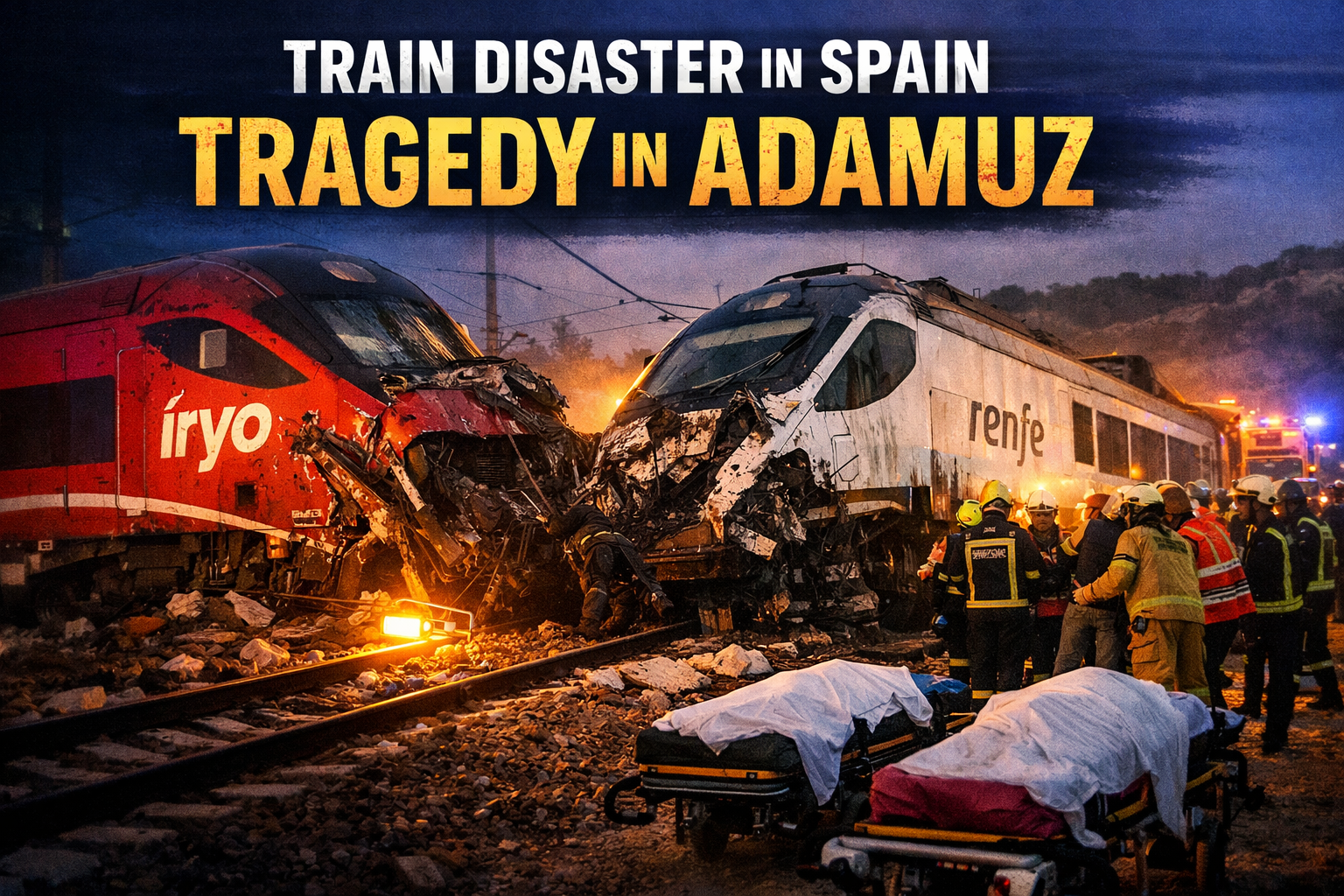
On a quiet Sunday evening in southern Spain, an unimaginable disaster unfolded near the city of Córdoba. The country’s bustling high-speed rail network, one of the largest in the world, became the scene of Spain’s worst rail crash in more than a decade. A high-speed train collision in Spain claimed at least 21 lives and left dozens more injured, sending shockwaves across the nation.
The crash involved two trains: one traveling from Málaga to Madrid, operated by Iryo, and another from Madrid to Huelva, operated by state-funded Renfe. In total, around 400 passengers and staff were aboard both trains. Emergency services were immediately mobilized, but the chaos left rescuers struggling to reach those trapped inside the twisted metal carriages.
The Moment of Impact
According to reports from Adif, the Spanish rail network operator, the first train derailed just ten minutes after leaving Málaga at 18:40 local time (17:40 GMT). The carriages crossed over to the opposite track, colliding head-on with the oncoming train from Madrid. The force of the collision pushed the second train into an embankment, primarily affecting the front carriages where most fatalities occurred.
Survivors described the experience as terrifying. Journalist Salvador Jimenez, who was on one of the trains, said the impact felt like an “earthquake.” José, a Madrid-bound passenger, recalled, “There were people screaming, calling for doctors. It was chaos.”
The high-speed train involved was a Freccia 1000, capable of speeds up to 400 km/h (250 mph). Rail experts were baffled by how such a collision could occur on a straight stretch of track. Spanish Transport Minister Óscar Puente described the incident as “extremely strange,” promising a full investigation.
Rescue Operations Amid Wreckage
Emergency responders faced severe challenges reaching victims. Córdoba Fire Chief Francisco Carmona said, “We had to remove a dead person to reach someone alive. It is hard, tricky work.” The Spanish Red Cross deployed teams to the scene, offering both medical assistance and psychological support to the families.
Advanced medical posts were set up in Adamuz, as well as at stations in Córdoba, Seville, Málaga, Madrid, and Huelva, to treat injured passengers. Dozens of seriously injured, including four children, were rushed to nearby hospitals. The chaos and urgency highlighted the scale of the disaster, with rescue workers navigating twisted carriages to save lives.
Nationwide and International Reactions
Spain’s Prime Minister, Pedro Sánchez, called it a “night of deep pain,” while the mayor of Adamuz, Rafael Moreno, described the scene as a “nightmare.” King Felipe VI and Queen Letizia expressed concern, sending condolences to victims and families. European leaders, including French President Emmanuel Macron, Italian Prime Minister Giorgia Meloni, and European Commission chief Ursula von der Leyen, also extended sympathies.
This tragedy revived memories of Spain’s worst high-speed train derailment in Galicia in 2013, which left 80 dead and 140 injured. Experts are calling for comprehensive safety reviews to ensure such accidents do not recur.
Impact on Spain’s High-Speed Rail Network
Following the collision, all rail services between Madrid and Andalusia were suspended, expected to remain closed for at least a day. Thousands of passengers were stranded, and families desperately sought information about loved ones on both trains. Emergency agencies advised survivors to contact their families or post on social media to confirm their safety.
Spain’s high-speed rail network, the second largest in the world behind China, spans over 4,000 km (2,485 miles) and connects more than 50 cities. This collision has raised serious concerns about operational safety on high-speed routes, even on well-maintained straight tracks.
Personal Stories From the Scene
Among the survivors, accounts of bravery and despair emerged. Some passengers helped others escape through windows and doors, while others comforted injured strangers. One young child, separated from their family amid the wreckage, was rescued by a volunteer who guided them to safety.
The human toll was compounded by emotional distress. Families waited anxiously at stations for news, while emergency teams worked tirelessly under pressure. Many described the scene as surreal—a blend of horror and urgency, with wrecked carriages scattered across the tracks.
Investigation and Safety Concerns
The official cause of the high-speed train collision in Spain remains unknown. The Spanish Transport Ministry expects the investigation to take at least a month. All railway experts consulted are “extremely baffled” by the accident, indicating that preliminary checks have not revealed any immediate explanation.
Questions have arisen about track conditions, signaling systems, and operational protocols. Authorities have stressed the importance of learning from this tragedy to prevent future incidents.
Long-Term Implications
Rail safety has come under scrutiny. While Spain’s high-speed rail is known for efficiency and speed, this disaster shows that even advanced systems are vulnerable. The collision may lead to stricter regulations, enhanced safety audits, and improved emergency response planning.
Passengers and families affected by the crash are seeking justice and assurances for safer travel. Meanwhile, the nation mourns, and emergency services continue their work at the scene and hospitals.
FAQs
Q1: How many people died in the Spain train collision?
A: At least 21 people were killed, with dozens injured, including children.
Q2: Where did the train collision occur?
A: The collision occurred in Adamuz, near Córdoba, southern Spain.
Q3: Which trains were involved?
A: A Málaga-bound Iryo train and a Madrid-Huelva Renfe train collided head-on.
Q4: What caused the train crash?
A: The official cause is still under investigation; authorities expect results in about a month.
Q5: How has the government responded?
A: Rail services were suspended, emergency services deployed, and an official investigation launched. National leaders and European officials offered condolences.